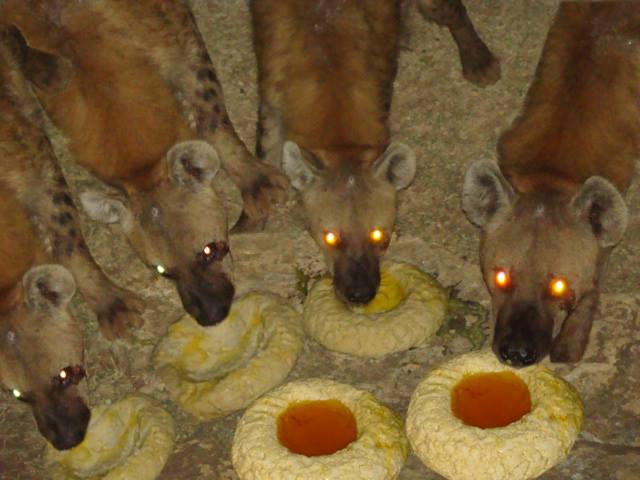
The occasion of ‘Ashura can be seen to mark the thematically related opportunity to forecast the upcoming year. Although a simple system through which to make predictions, the feeding of the hyenas on this occasion reveals something of the complexity of relations between different elements in the environment of Harar. It involves offering a bowl of multigrained porridge known as shure to the hyenas that inhabit the hills around Harar, and forecasting the forthcoming year on the basis of how much of the shure they consume. On ‘Ashura, shure is prepared in every Ge gar and at the major awach. The dermach, having smashed the gourds in the early evening, return to their homes, or the homes of their friends to eat the shure that has been prepared. Shure is a thick porridge which is usually made from wheat, although it may be made from a combination of wheat, maize and sorghum. It is familiar food for special occasions, although when served at other occasions it is known as hareesa and most basic in form. While individual households prepare a simple version of shure, flavoured with butter, sugar or red pepper, more elaborate versions may be prepared at the major saints’ shrines for mass consumption and for feeding the hyenas.
In this case, the whole grain porridge may be augmented with pieces of meat, spices and onions over which a lavish amount of butter is poured. Shure is, both nutritionally and symbolically, food for security, and even the private consumption of shure in Ge usu’ homes on this occasion contributes to an overall sense of peace and security within the community for the forthcoming year. On this day, people are expected to stuff themselves full of this traditional food. Filling their stomachs with this dense porridge ensures that they will not feel hunger on any other day of the year. This aspect of tradition, many Ge usu’ tell, is carried out in other Muslim countries. The Pan-Islamic traditions associated with the consumption of shure make reference to major events in the history of religion. They are events which Ge usu’ use in the suggestion of the significance of shure for themselves as Muslims. Ge usu’ believe that this month, Muharram, like Safar, is potentially dangerous. I look firstly here at
how ‘Ashura is understood locally in terms of the overall history of Islam, and secondly and more significantly, at the beliefs various Ge usu’ hold about how the occasion has directly affected them as a population, and manifested itself accordingly in their urban environment.
Ahmed Zekaria, in an English language newspaper article, refers to a set of beliefs associated with ‘Ashura, which have a biblical reference. He states that Ge usu’ believe first that it was on this day that Noah landed safely after the flood, and by way of thanksgiving the people on the ship prepared a porridge of various cereals (1994). In the fieldhave encountered variations on this story. According to one persistent version, when Noah’s Ark reached dry land his wife was in the kitchen cooking shure. The occasion of human salvation was thus celebrated with the consumption of shure.
The second association with the day is, according to Zekaria, that Moses is said to have escaped the oppressive yoke of the Pharaoh on this day. (ibid) Religious scholars in the field add that God saved Musa (Moses) on this day by striking a rod down on the earth and creating the Red Sea into which the Pharaoh and his men fell and drowned. In addition, the Prophet Ibrahim is said to have been saved from the burning fire of his opponents on this day. While Ge usu’ I have asked to explain ‘Ashura and the consumption of shure look to events in the overall history of Islam, they actively seek to determine and affect their fate through local practices associated with the occasion. Feeding the hyenas appears to be something which has developed as a result or consequence of the unique relationship Ge usu’ see their population as having with the hyenas around Harar. They are entertained on this occasion at a number of shrines located in the hills surrounding the city where the hyenas live, including Aw Nugus, Amir Talhah, Aw Hakim, Aw Sofi, Aw Sayid Ali, Aw Aboker, AwAbdal, and Aw Qurabe Limay. The hyenas are nocturnal creatures, and so shure is prepared for them after dark and placed in huge stone gabatach, or bowls, used expressly for this purpose, around which Ge usu’ wait expectantly on the eve of ‘Ashura.
Source Ahmed Zakrya