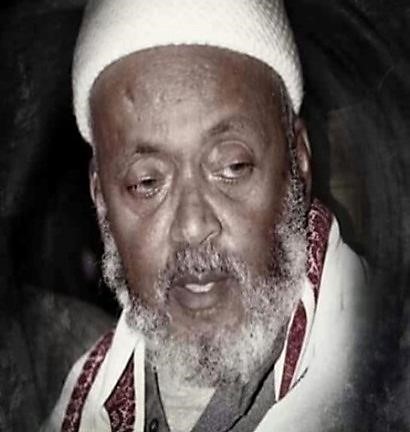
Ab. Abdallahi al-Harari, b. 1910, Harar, d. September 2008, Beirut was a prominent Muslim leader in Ethiopia and beyond, a religious scholar and the founder of the International Association of Islamic Charitable Projects, also known under the designation al-Aḥbash. (to mean Ethiopian) He attained Islamic education in different parts of Ethiopia and grew to be a firm believer in Islamic-Christian co-existence. During the period between 1941 and 1948, he became involved in the struggle over the leadership of Harar’s Islamic community, which revolved around two issues:
First, in 1941 a group of Harari-Islamic nationalists re-established a local modern school in the spirit of Wahhabi fundamentalism. A few months later, the Ethiopian authorities closed the school and sent those involved either to prison or into exile.
Second, between 1946 and 1948 the same Islamic nationalist circles in Harar collaborated with the Somali nationalist movement that planned to secede Harar from Ethiopia and annex it to Somalia. In addition, the Ethiopian authorities baffled this plan and its leaders were punished. In both cases, the defeated group accused sheikh A. of being instrumental in helping the Ethiopian establishment. Sheikh ʿA. and his followers continue to deny any anti-Islamic collaboration, pointing to the fact that in 1948 ʿA. himself suspected by the Ethiopian imperial regime, jailed for a time and then forced to leave the country.
After leaving Ethiopia, Shakh ʿA. spent some time in Mecca and in late 1948, in Jerusalem from where he moved to Damascus. In 1950, he moved to Beirut Lebanon where he resided until his death. In 1983, he inherited the leadership of a local Islamic association and gradually turned it into an international movement called Association of Islamic Charitable Projects. By that time, he had gained fame as a thinker, author – he had published up to 20 books, a mufti and was religious preacher. His main message remained the one that he had brought from Ethiopia and was centrally relevant to Lebanon, that of Islam-Christian peaceful co-existence. He won the indirect support of the Lebanese Christian establishment and various Islamic publics as well as the support of the Syrian government. The Association flourished in Lebanon. It has issued a monthly, Manar al-Huda, since 1992, and has had its own radio station, Nidaʾ al-maʿrifa, since 1998. Its members are very active on the internet and have websites that spread the words of shakhʿA and his polemics with their rivals. Its messages, always based on moderate interpretations of Sunni Islam.
The worldwide Lebanese diaspora helped the Association of Islamic Charitable Projects to become a transnational association in the 1980. Its main centre in Europe was in Germany and active branches spread throughout most of Western parts of Europe. The association also has branches in countries such as Indonesia, Malaysia, India, Pakistan, Tajikistan, Syria, Jordan, Egypt, Canada, Switzerland, France, Ukraine, The Netherlands, Sweden, Australia, and the USA. They are also active in Africa, notably in Nigeria and Ghana, where they try to create a bridge between local Muslims and those of the Middle Eastern core. By the end of the 1990, the Association of Islamic Charitable Projects had become one of the best-organized transnational Islamic associations in many countries, claiming nearly a quarter of a million members.
The movement is composed of Muslims from various other ethnic and linguistic backgrounds. The number of Ethiopian members is not known, but there are not many. For his followers ʿA. is one of the greatest-ever scholars of Islam, and they refer to him with such titles as ‘al-imam al-muḥaddit or muḥaddit al-ʿaṣr’, namely the leader of ḥadith scholarship and the ḥadith scholar of our time. ʿA. himself took pride in his all-Islamic and allegedly Arab background but at the same time, he also took full pride in his Ethiopian identity. He returned to Ethiopia three times, in 1969, 1995, and 2003. It is also apparent that his many followers identify him with what Ethiopia symbolizes for the more moderate Muslims, an Islam, capable of co-existing with the Christian other.
Src: DANIEL NASSIF, “Dossier: Al-Ahbash”, Middle East Intelligence Bulletin 3, 4, April 2001 (http://www.meforum. org/meib/articles/0104_ld1.htm; last access 14 June 2013).
Lit.: HAGGAI ERLICH, Ethiopia and Saudi Arabia: Christianity, Islam, and Politics Entwined, Boulder, CO –London 2007, ch. 3; HARSI MUḤAMMAD HAYLULA, Muḫtaṣar alʿaqida al-sunnĭya li-l-ʿallama ʿAbdallah al-Harari (‘Summary of the Sunni Creed by the very learned ʿAbdallah al-Harari’), Malaysia n.d.; NIZAR HAMZA – R. HRAIR DEKMEJIAN, “A Sufi Response to Political Islamism: AlAhbash of Lebanon”, International Journal of Middle East Studies 28, 1996, 217–29; MUSTAFA KABHA – HAGGAI ERLICH, “Ahbash and the Wahhabiyya: Interpretations of Islam”, ibid. 38, 2006, 519–38. Haggai Erlich